

Launch day can make or break a game, especially for multiplayer titles where players expect every match to work immediately. When Torn Banner and Tripwire prepared to launch Chivalry II, they needed infrastructure that could scale fast and keep the experience stable.
They turned to Gameye to make sure they could handle traffic spikes across five platforms and 30 locations, without paying for large amounts of idle capacity in advance.
We handled a surge of players on launch day
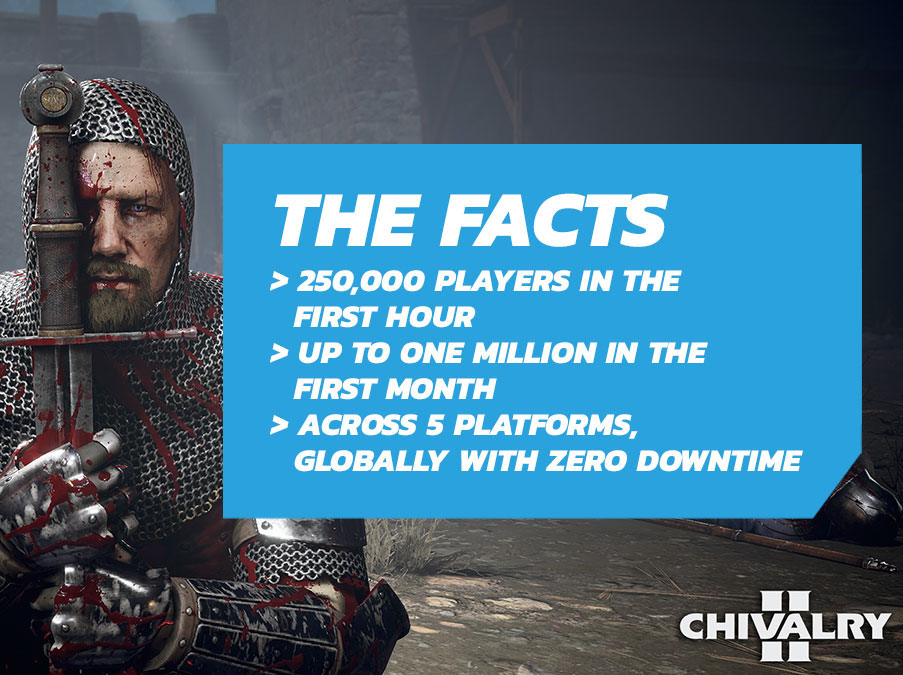
Player demand exceeded projections quickly. In the first hour, session volume was roughly double expectations. Chivalry II reached more than 250,000 players at launch and nearly one million players in the first month.
Infrastructure stayed online with no major downtime events from hosting or orchestration.
The need for a new multiplayer solution
During development, the team had outgrown their previous setup. The old model made it difficult to scale on demand and forced them to pay for capacity that often sat unused.
They needed a platform that could expand and contract with real player behavior while preserving launch reliability.
Why Gameye
Gameye integrated with their match flow through API-driven session orchestration. Sessions were allocated automatically, and capacity expanded when demand rose.
From the player perspective, gameplay stayed consistent. From the studio perspective, operations became more predictable and easier to manage globally.
Innovation takes a bold step
Adopting a new hosting model close to launch carried risk. The team focused on joint testing and incremental validation so integration issues were identified early.
"When we spoke to Gameye, I'll be honest, we weren't sure it could be done."
As launch approached, forecasts were revised upward again. Additional capacity was provisioned in hours, not weeks, which gave the team confidence heading into open beta and release.
Outcomes
Chivalry II launched at significantly higher concurrency than projected while staying operationally stable. With infrastructure concerns reduced, the team could focus on gameplay issues and player support during the most critical release window.